Trim, Doors & Ceilings
The linear-foot parts of a paint job, which never scale with floor area.
Trim is a small fraction of a room's square footage and often a third of its painting time. It is estimated by the linear foot, painted in a different product from the walls, and it is where a room reads as finished or does not.
How much paint
Baseboard, casing and crown are measured in linear feet and converted by width:
- 3 1/4 in baseboard — about 3.6 linear feet per square foot of surface
- 2 1/4 in casing — about 5.3 linear feet per square foot
- 4 1/2 in crown — about 2.7 linear feet per square foot
A 12 × 14 ft room has 52 linear feet of wall. With baseboard and crown, and casing around one door and two windows, that is roughly 45 ft² of trim surface — about 1/8 of a gallon per coat, and trim wants two coats.
A door is roughly 40 ft² for both faces plus the edges, and a six-panel door is nearer 45 because the profiles have more surface than the slab does. Figure a quart per door for two coats.
Which is why a quart of trim enamel does a small room and a gallon does most houses.
Which product
Not wall paint. Trim takes handling, cleaning and impact, so it wants a harder film: a waterborne alkyd or acrylic enamel. These flow out like oil, level brush marks, cure hard over several days, and clean up in water.
Sheen for trim is semi-gloss in most houses and satin where a softer look is wanted. Flat trim is a specification, not an accident, and it does not survive a kitchen.
Cure time is not dry time
Waterborne enamel is dry to touch in an hour and fully cured in 14 to 30 days. Stacking books against a freshly painted shelf, or closing a door onto a freshly painted jamb, at day three is how the paint pulls off in sheets. Talc on the jamb stops the sticking while it cures.
Order of work
Ceiling, then walls, then trim — is the common advice, and it is wrong for a room with existing trim.
Paint the trim first, cut the walls to it afterward. Wall paint cuts against trim more easily than trim paint cuts against a wall, because the trim gives you an edge to run a brush along and the wall does not. Professionals mask nothing and work in this order.
The prep that matters
Fill nail holes with a lightweight filler and sand flush, caulk every joint where trim meets wall, and sand the existing gloss. Caulk is the step that makes new trim look installed rather than nailed on, and it is the one skipped most.
1 article
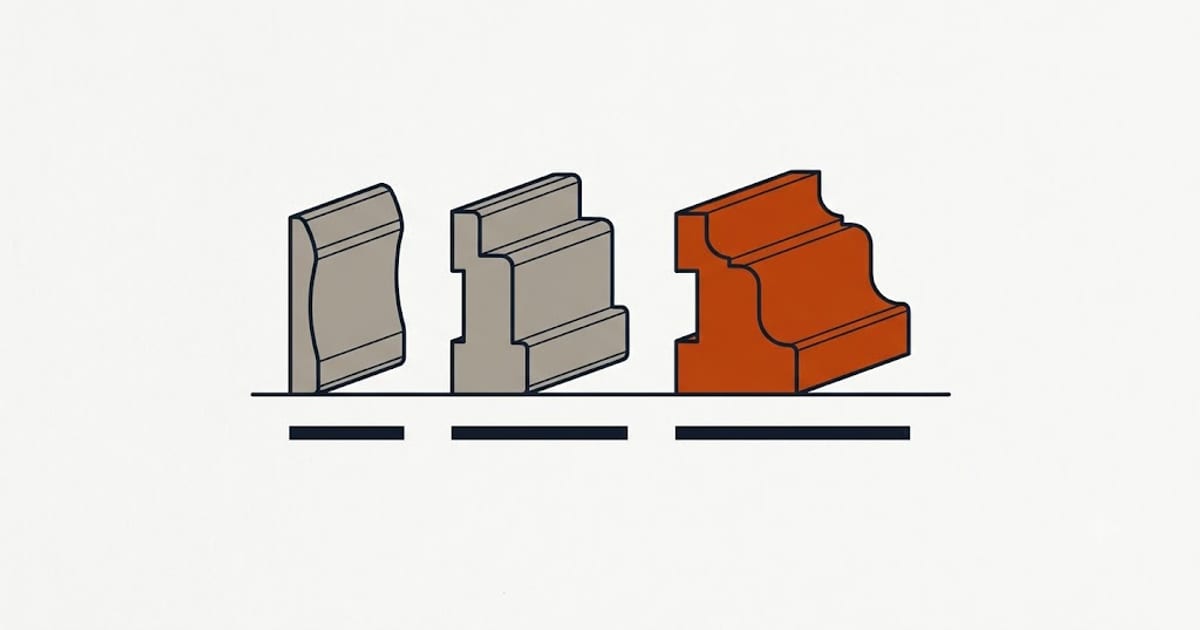 How Much Trim Paint a Room Takes: Linear Feet to Gallons
Trim is measured in linear feet and sold in gallons. The conversion is a division by the profile width, and a door is worth more than a whole room's baseboard.