Ceilings are quoted separately from walls, and when a painting bid comes in unexpectedly low, ceilings are usually what is missing from it.
The rates
| Ceiling | Cost per ft² | 12 × 14 room, 168 ft² |
|---|---|---|
| Smooth, 8 ft, same colour | $1.20–2.20 | $200–370 |
| Smooth, 9–10 ft | $1.60–2.80 | $270–470 |
| Textured — orange peel, knockdown | $1.50–2.60 | $250–440 |
| Popcorn, painting over | $1.80–3.20 | $300–540 |
| Popcorn removal + skim + paint | $3.50–6.50 | $590–1,090 |
| Vaulted or cathedral | $2.60–5.00 | — |
| Stain-blocking over water damage | +$0.40–0.90 | — |
Compare with $0.90–1.60 per square foot for walls. A ceiling costs 30–60% more for the same area.
Why
Gravity. Paint applied overhead runs, drips and sags. It is applied thinner and slower, and the roller has to be loaded less.
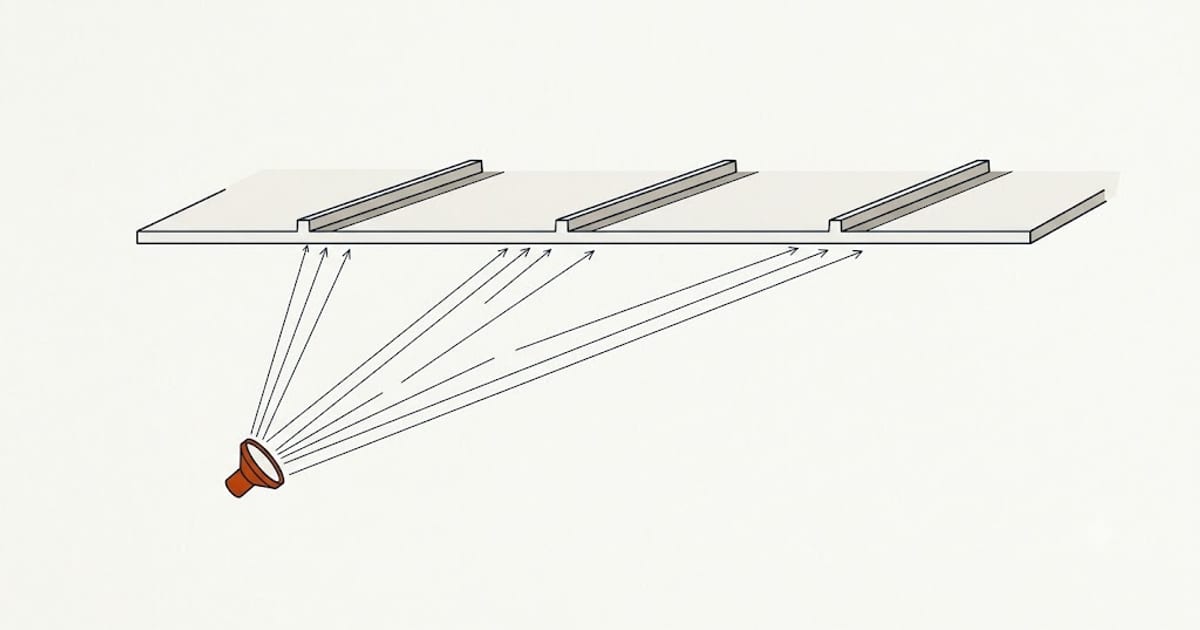
Raking light. Every lamp in a room lights the ceiling from below at a shallow angle. That is the worst possible light for showing surface imperfection, which is why ceilings are painted flat almost without exception — the sheen is doing the work the surface cannot.
It is also why ceiling defects that a wall would hide become visible: roller lap marks, a joint that was finished to level 3, a patch feathered too tightly.
No stopping. A ceiling has to be finished wet-edge to wet-edge in one pass. A wall can be broken at a corner; a ceiling cannot be broken anywhere without leaving a lap mark. That means a room's ceiling is one continuous operation, and a large open-plan ceiling may need two people.
Masking. Walls, trim, floor and everything in the room, all of it below the work. Interior masking on a ceiling-only job is most of the setup time.
Neck and arms. It is simply slower work, and the rate reflects a slower pace.
Popcorn
Two things change the price completely.
Pre-1980 texture may contain asbestos. Test before disturbing it — $30–80, and non-negotiable. Removal of asbestos-containing texture is abatement, with licensing and a cost several times a normal removal.
Painted popcorn does not scrape off. Unpainted texture wets and comes away. Painted texture resists water and has to be skimmed over or boarded over instead, which is a full skim-coat operation with a skim-coat price.
Painting over popcorn is possible but it is a one-way door — it is what makes the texture unscrapeable — and it takes considerably more paint because the surface area is far greater than the plan area. Spray it; rolling popcorn pulls the texture off in patches.
When to include ceilings in a repaint
Yes, when the walls are changing colour. Cutting a new wall colour to an old ceiling leaves a visible line at the top of every wall, and the old ceiling will look yellow against fresh paint whether or not it actually is.
Yes, if there is any smoke, cooking or water history. Ceilings collect all three, and a stain that is invisible under old paint reappears through new wall paint at the corner.
No, if the ceilings are recent, clean and staying white, and the walls are getting a similar shade. This is the case where skipping them is genuinely reasonable, and it removes 20–30% from a whole-house quote.
Materials
Ceiling paint is a genuinely different product, not a marketing variant: very flat, high in pigment, and formulated thick with a longer open time so it does not spatter or run and so the wet edge stays workable.
Coverage runs 350–400 ft² per gallon on smooth, and considerably less on texture — orange peel around 300, popcorn as low as 200. A gallon does a 12 × 14 smooth ceiling with room to spare.
Most ceiling paints go on tinted pale pink or blue and dry white, which solves the real problem: white-on-white gives no way to see what has been covered, and a missed strip appears only when the paint dries.
Stains
Water stains bleed through latex within days. They need a shellac-based stain blocker — spot the stain, let it dry, then paint. A latex "stain-blocking" primer will not hold back a water stain, and this is the most common ceiling callback there is.
Nicotine and smoke need the same treatment across the whole ceiling rather than in spots.
Doing it yourself
Ceilings are the part of an interior job most worth hiring out, and the reasoning is straightforward: it is the surface where mistakes are most visible, the work is physically unpleasant, and it is the least of the total scope.
A 12 × 14 ceiling is $200–370 against a whole-house quote of $7,000–12,000 — a small share of the total and the share most likely to look amateur.
If you do it yourself: an 18 in roller with a 3/4 in nap on an extension pole, cut in first, and work in 4 ft wide strips across the short dimension of the room, keeping every strip's edge wet.