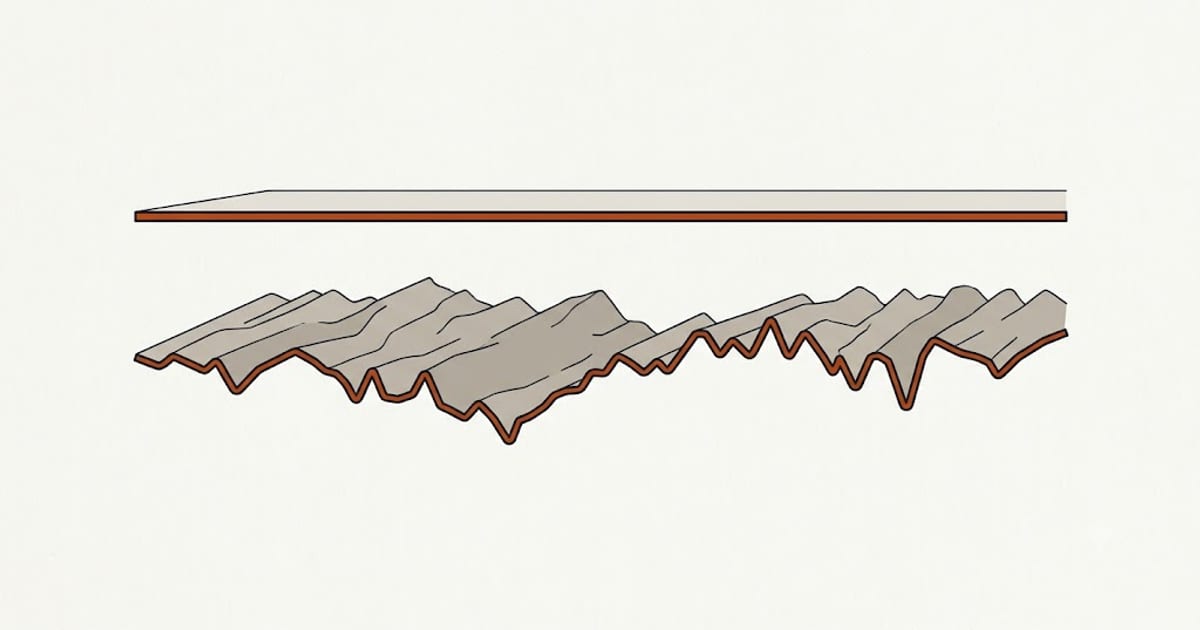
The coverage figure on a paint can — typically 350 to 400 square feet per gallon — is measured on a smooth sealed surface. It is accurate.
A textured wall's plan area and its actual surface area are different numbers, and on heavy stucco they differ by a factor of three.
Coverage by masonry substrate
| Surface | First coat | Second coat |
|---|---|---|
| Smooth siding, for reference | 350–400 ft² | 360–410 ft² |
| Smooth / sand-finish stucco | 250–300 ft² | 300–350 ft² |
| Medium stucco — lace, dash | 180–240 ft² | 230–290 ft² |
| Heavy stucco — Spanish lace, knockdown | 140–190 ft² | 190–250 ft² |
| Smooth face brick | 180–240 ft² | 260–320 ft² |
| Rough or wire-cut brick | 130–180 ft² | 190–250 ft² |
| Concrete block, unfilled | 120–160 ft² | 200–260 ft² |
| Block with block filler applied | 250–300 ft² | 300–350 ft² |
Two effects are stacked here. Texture adds real surface area, and unsealed masonry is porous — it absorbs paint into the substrate as well as coating it.
Which is why the second coat is dramatically better on these surfaces than on siding: the first coat has filled the pores and bridged the worst of the texture.
Estimating a real house
A 2,000 ft² single-storey house has about 2,300 ft² of wall.
| Substrate | Two coats | Gallons |
|---|---|---|
| Smooth siding | 2,300 ft² | 12 |
| Sand-finish stucco | 2,300 ft² | 17 |
| Heavy stucco | 2,300 ft² | 26 |
| Rough brick | 2,300 ft² | 24 |
Heavy stucco takes more than double the paint of smooth siding for the same house. At $45–70 a gallon for quality exterior acrylic that is $630–980 of difference, which is enough to matter in a bid even though materials are only 12–20% of an exterior job.
The smooth-siding figures are the wrong starting point for any masonry wall.
Block filler is not primer
Concrete block has open pores that no amount of paint will bridge economically. Block filler is a high-solids product designed to fill them — thick, applied heavily, and rated at 75–125 ft² per gallon.
It looks expensive per gallon and it is much cheaper than using three coats of finish paint to do the same job, which is the alternative.
Once filled, block takes paint at close to smooth-surface rates.
Primers for masonry
| Substrate | Primer |
|---|---|
| New stucco, under 30 days | Wait, or use a high-alkali-resistant primer |
| Cured stucco | Masonry / alkali-resistant acrylic |
| Bare brick | Alkali-resistant masonry primer |
| Concrete block | Block filler, then primer if specified |
| Chalking painted masonry | Oil-based penetrating conditioner |
The alkali point is a real one. Fresh Portland-cement products are strongly alkaline and will saponify an ordinary coating — the paint chemically breaks down and comes off in sheets. New stucco should cure 28 to 30 days before painting, or take a primer formulated for high pH.
Elastomeric on stucco
A thick, flexible coating that bridges hairline cracks. It goes on at 60–110 ft² per gallon — three to six times the film of ordinary paint — and costs proportionally more.
It is genuinely useful on stucco with a history of hairline cracking. It has one significant drawback: it is close to vapour-impermeable, so on a wall with any moisture coming from behind, it traps it and blisters.
Use it on stucco that cracks. Do not use it as a general upgrade.
Brick is a one-way decision
Painted brick is very difficult to return to unpainted. Stripping is expensive and usually damages the face, and paint on brick reduces the wall's ability to dry outward unless a vapour-permeable masonry coating is used.
Mineral silicate paints are the technically better answer on brick — they bond chemically into the masonry and remain highly permeable — and they cost more and come in fewer colours.
Application
Spray and back-roll, always, on texture. Spraying alone lays paint across the peaks and leaves the valleys thin, so the film is inconsistent exactly where water collects. Back-rolling with a long nap — 3/4 in for medium texture, 1 to 1 1/4 in for heavy — works the paint into the profile.
Nap length is worth getting right: a short nap on heavy stucco will not reach the valleys at any spread rate, and the wall will look painted and fail early. The spray-versus-roll trade covers the rest.
Buy 15% over
On texture, estimate from the table, then add 15%. Texture varies across a single wall — patched areas, different trades, different eras — and running short mid-wall on a sprayed job means a visible stop line that a second batch will not perfectly match.