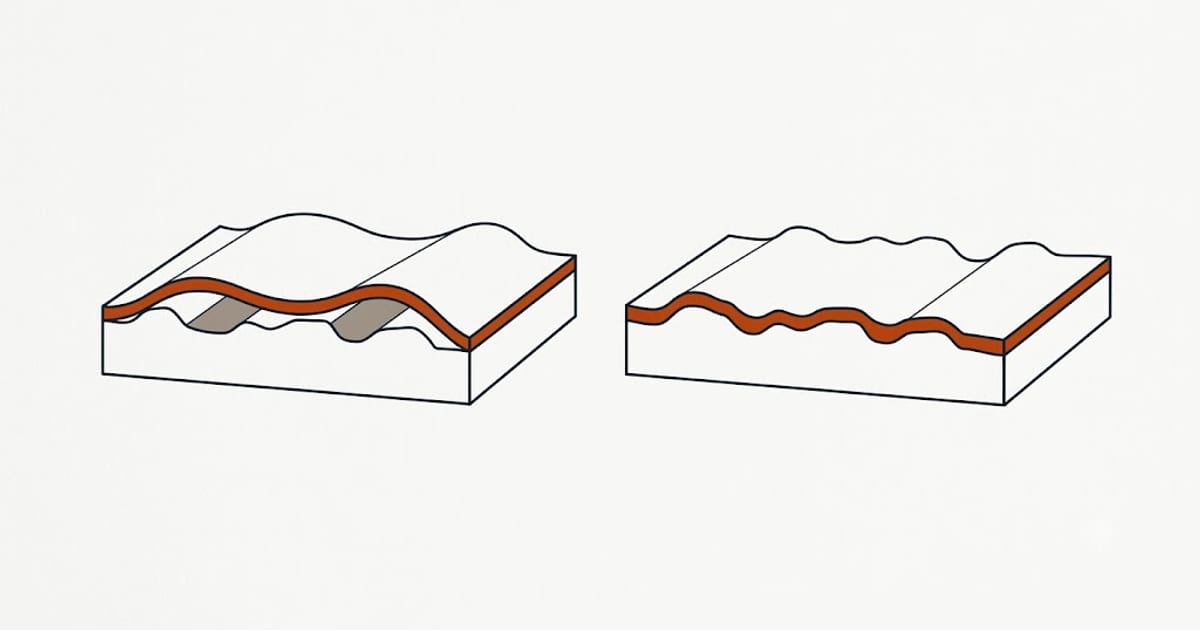
Almost all professional exterior work is sprayed. The question is not really spray or roll — it is spray alone, or spray followed by a roller.
Speed
| Method | Rate on open siding |
|---|---|
| Brush | 100–150 ft² / hr |
| Roll | 250–400 ft² / hr |
| Spray | 900–1,400 ft² / hr |
| Spray + back-roll | 500–750 ft² / hr |
On a 2,300 ft² house that is roughly two hours of spraying against seven of rolling, per coat.
The figure that changes the calculation is masking. A house with many windows, close landscaping, a neighbour's car in the driveway and a fence to protect can need three to four hours of masking before a two-hour spray. On a small, cut-up house with a lot to protect, rolling can genuinely finish first.
Material
Spraying uses 20–40% more paint. Two causes, and only one of them is waste.
Overspray — paint that never lands on the wall. Wind makes this much worse; above about 10 mph a sprayer is throwing material away and coating the neighbourhood.
Film build — a sprayer lays down a thicker wet film than a roller does, and that thicker film is part of why sprayed work looks even. It is paid for and it is on the wall.
On a house needing 12 rolled gallons, budget 15–17 sprayed.
Back-rolling
This is the part that matters, and it is what separates a spray job that lasts from one that does not.
A sprayer atomises paint and deposits it on the surface. On a smooth, sealed substrate that is fine. On anything porous or textured — wood, stucco, brick, fibre cement with a profile — the droplets land on the high points and bridge the low ones, leaving a film that sits on the surface rather than keyed into it.
Back-rolling means following the sprayer with a roller within a couple of minutes, working the wet paint into the surface. It:
- pushes paint into pores and profile valleys
- evens out the film thickness
- removes the bridged voids where water would otherwise sit
Where back-rolling is required: bare or previously bare wood, all stucco, brick, block, and any first coat over a porous substrate. On textured masonry it is not optional at all — the nap length has to match the texture depth or the valleys never get coated.
Where spraying alone is acceptable: second coats over a sound sealed first coat, vinyl, aluminium, and previously painted smooth siding in good condition.
A quote that says "spray two coats" on a wood house and does not mention back-rolling is worth one question.
Where each belongs
Spray — large open elevations, fibre cement, vinyl, aluminium, stucco, anything with repetitive detail like shingle siding where a brush would take days.
Roll — flat open siding on a small house, second coats, and any job where masking would take longer than painting.
Brush — windows, doors, hand rails, tight cut lines, and anything adjacent to something that cannot be masked. Every sprayed house still has a day of brush work.
What spraying does badly
Wind. Above 10 mph, stop. Overspray travels much further than people expect and settling on a car two doors down is a real and expensive outcome.
Detail. Cutting a straight line between siding and trim with a sprayer means masking the trim. On a house where trim is a different colour, that masking is most of the job.
Thin spots on texture. Without back-rolling, sprayed film on heavy texture is thinnest in the valleys, which is where water collects and where failure starts.
Old, chalky, or poorly prepped surfaces. Spraying is fast enough that it tempts a crew past prep. Paint sprayed over chalk fails exactly as fast as paint rolled over chalk — and prep is half the job cost precisely because it is the half that decides the life.
Equipment
An airless sprayer capable of exterior work rents at $70–120 a day and buys for $400–1,200. Add tips, filters, hose, and a couple of hours of cleaning per day of use.
For a single house, one coat, the rental plus masking materials plus the extra paint often lands close to the cost of rolling it. For two coats, or for a textured house, spraying wins clearly.
Whichever method
Surface temperature governs the schedule, not air temperature — and a west wall in afternoon sun runs far hotter than the forecast. Paint applied to a hot surface flashes off before it can level or wet the substrate, which produces exactly the poor adhesion back-rolling exists to prevent. The temperature window is worth more to the result than the application method is.