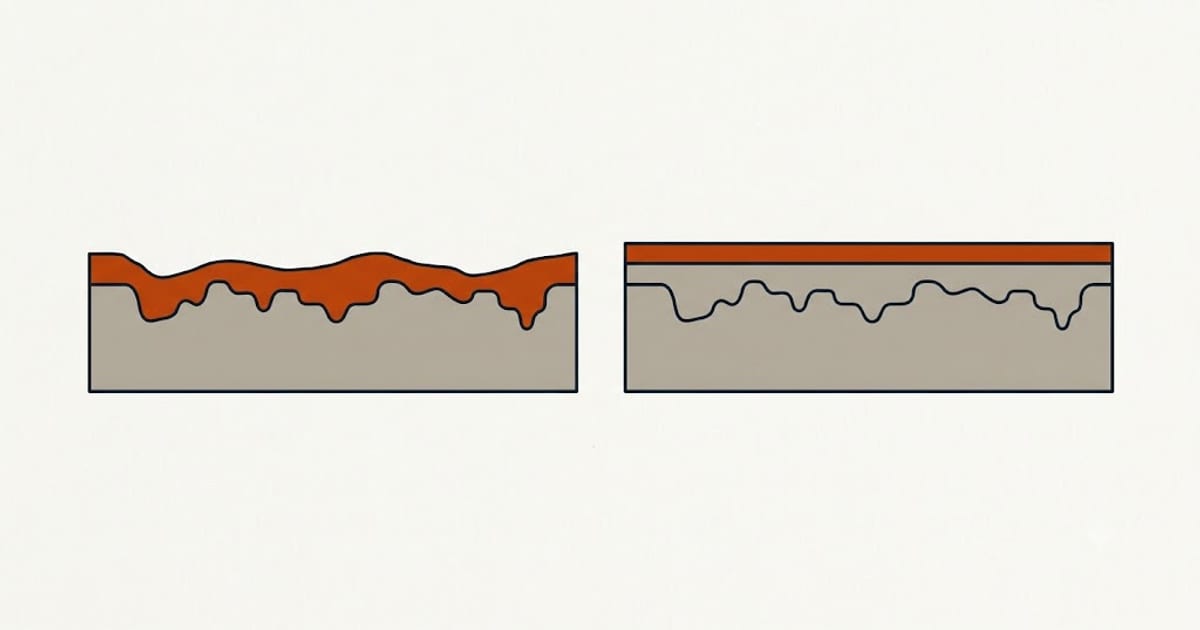
The second coat almost always goes further, and how much further depends entirely on what the first coat was covering.
The numbers
Coverage per gallon, interior latex, roller applied.
| Substrate | First coat | Second coat | Saving |
|---|---|---|---|
| New drywall, unprimed | 200–275 ft² | 300–350 ft² | ~30% |
| New drywall, PVA primed | 320–360 ft² | 380–420 ft² | ~15% |
| Previously painted, sound | 350–400 ft² | 360–410 ft² | ~3% |
| Bare wood | 200–250 ft² | 320–380 ft² | ~35% |
| Smooth plaster | 340–380 ft² | 380–420 ft² | ~10% |
| Textured — orange peel | 250–300 ft² | 300–350 ft² | ~17% |
| Popcorn or heavy texture | 150–220 ft² | 200–280 ft² | ~25% |
Why
Paint applied to a porous surface loses part of its volume into the substrate. The binder soaks into the paper facing of drywall or into the grain of bare wood, leaving less film on the surface. That absorbed portion is not wasted — it is what bonds the coating — but it comes out of the gallon.
The first coat is therefore doing two jobs: sealing and colouring. Once the pores are full, the second coat only has to build film, so it spreads further.
Follow that logic and the case where there is no saving becomes obvious: a previously painted wall is already sealed. Both coats are just film build. Estimating a second coat at 30% less on a repaint is how a job runs short on the last wall.
Which is why primer exists
Primer is formulated to be absorbed. It costs less per gallon than finish paint, seals in one pass, and lets both topcoats spread at their full rate.
On new drywall: two coats of paint direct is roughly 240 + 325 = 565 ft² per two gallons. Primer plus two coats is 250 (primer) + 340 + 400 = far better coverage per gallon of the expensive product, and a more uniform surface.
Primer coverage runs lower than paint — 200–300 ft² per gallon on new drywall — because absorbing is its job. Primer quantities are worth working out separately rather than assuming paint rates.
Colour change breaks the rule
Coverage and hide are different properties, and the table above is about coverage.
A dramatic colour change can need a third coat regardless of how much the surface is absorbing. Deep and saturated colours are the worst: deep bases carry very little white pigment, so a red or a deep blue over white can take three or four coats to look even.
The fix is not more topcoat. It is a tinted primer at 50% of the topcoat formula — most stores will do it at no charge — which brings a four-coat job back to two. How tinting works and when it pays is worth reading before buying the third gallon.
Going the other way, white over a dark wall has the same problem with the opposite cause.
Buying for two coats
The honest way to estimate:
gallons = wall area ÷ first-coat rate + wall area ÷ second-coat rate
For a room with 420 ft² of wall over primed drywall: 420 ÷ 340 + 420 ÷ 400 = 1.24 + 1.05 = 2.3 gallons. Buy 3, or 2 plus a quart.
Do not use a single average rate for both coats on new work; it understates the first coat and the shortfall always lands on the last wall of the first coat, which is the worst place for it.
The per-surface rates for the first coat are in coverage by surface.
When to skip the second coat
Rarely, and only when all three hold: the surface was previously painted, the new colour is close to the old one, and the sheen is flat.
Flat paint is forgiving of a thin spot. Anything with sheen is not — one coat of eggshell over a sound wall dries with visible variation in reflectance wherever the roller worked differently, and the only fix is a second coat.
Buy it all at once
One more reason not to under-buy: paint is tinted in batches, and two gallons of the same colour mixed weeks apart can differ enough to see on a long wall.
Buy the full quantity in one purchase, and box it — pour all the gallons into a single bucket and mix — before starting. That removes batch variation entirely, and it costs nothing but a five-gallon pail.