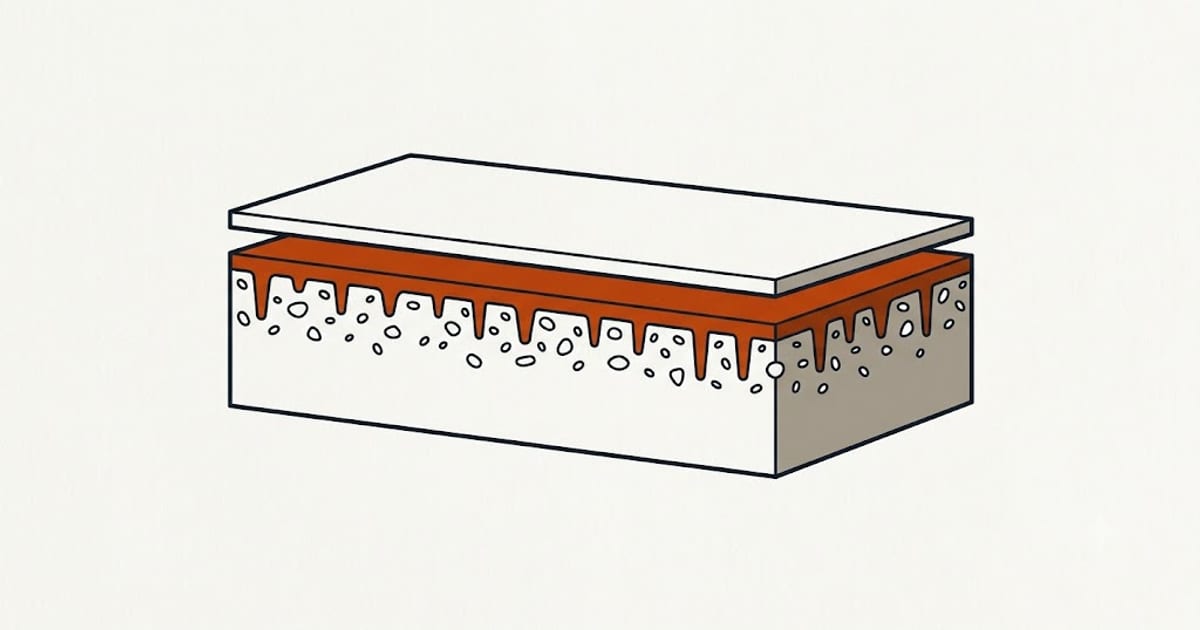
Primer is not thin paint, and it does not cover like paint. It is formulated to be absorbed into a substrate and to seal it, which means part of every gallon goes into the wall rather than onto it.
That is the product working correctly, and it is why the number on the can is lower.
Coverage by substrate
| Substrate | Primer | Paint, first coat |
|---|---|---|
| New drywall, PVA primer | 200–300 ft² | 320–360 ft² |
| Skim-coated / level 5 drywall | 300–350 ft² | 350–400 ft² |
| Bare softwood | 200–250 ft² | 200–250 ft² |
| Bare hardwood | 250–300 ft² | 250–300 ft² |
| Glossy painted surface, bonding primer | 300–350 ft² | — |
| Previously painted, sound | 350–400 ft² | 350–400 ft² |
| Cured stucco, masonry primer | 150–250 ft² | 250–300 ft² |
| Bare brick | 130–200 ft² | 180–240 ft² |
| Concrete block, block filler | 75–125 ft² | — |
Block filler is the outlier and it is not really a primer — it is a pore-filling compound, and using finish paint to do that job takes three coats and costs far more.
The ratio to buy
For a typical interior job on new drywall:
1 gallon of primer per 1.3–1.5 gallons of finish paint
For a repaint over sound painted walls where primer is only spot-applied over patches:
1 quart per 3–4 gallons
For bare wood trim and doors:
1 gallon of primer per 1 gallon of finish, roughly equal, because bare wood absorbs both.
Where primer earns its place
Three jobs, and a surface needs primer if it needs any one of them.
Sealing porosity. New drywall, patched compound, bare wood and fresh masonry drink paint at different rates across their surface. Paint applied directly soaks in unevenly and dries to a patchy sheen that a second coat does not fix — the variation is under the paint, not in it.
Adhesion. Glossy, chalky or slick surfaces give a topcoat nothing to grip. A bonding primer builds the mechanical key.
Blocking. Tannin from cedar, redwood and knotty pine bleeds through latex as brown stains, and so do smoke, water stains and marker. These need a shellac or oil-based blocker. A latex "stain-blocking" primer over a water stain is a water stain again within a week, and it is the most common repaint callback there is.
Where you can skip it
Repainting a sound, clean, previously painted interior wall in a similar colour and the same sheen. That wall is already sealed, and two coats of a quality paint outperform primer plus one coat at a lower cost.
When primer is genuinely needed is worth settling before buying anything, because on a straightforward repaint it is a gallon that does not need to exist.
Which primer
| Surface | Primer |
|---|---|
| New drywall | PVA drywall primer |
| Level 5 / high-build requirement | High-build drywall surfacer |
| Bare softwood, knots | Shellac-based |
| Trim, for a hard enamel finish | Oil or waterborne enamel undercoat |
| Chalky exterior | Oil-based penetrating |
| Glossy existing paint | Bonding primer |
| Water, smoke, marker stain | Shellac-based, spot only |
| Bare masonry, stucco | Alkali-resistant masonry |
PVA drywall primer is cheap and correct on new board and wrong nearly everywhere else — it has minimal blocking ability and poor adhesion over gloss. It is also the primer most likely to be in the garage already, which is how it ends up on the wrong substrate.
Tinting changes the arithmetic
Where the topcoat is deep or saturated, tint the primer toward it. Deep bases carry little white pigment and hide poorly, so a red or a deep blue over white primer can take three or four coats to look even; over a grey-tinted primer it takes two.
Most stores tint primer to 50% of the topcoat formula at no charge, and it removes an entire coat of the most expensive paint in the store. How far to tint and when it pays is worth reading before committing to a deep colour.
Estimating both together
Work out the wall area, then use the substrate row from the table for the primer and the per-surface paint rates for the topcoats — and remember that the second coat goes further than the first by a margin that depends on the same porosity primer just dealt with.
Round up. Primer is the cheapest liquid in the job, and running out of it stops the first day rather than the last.