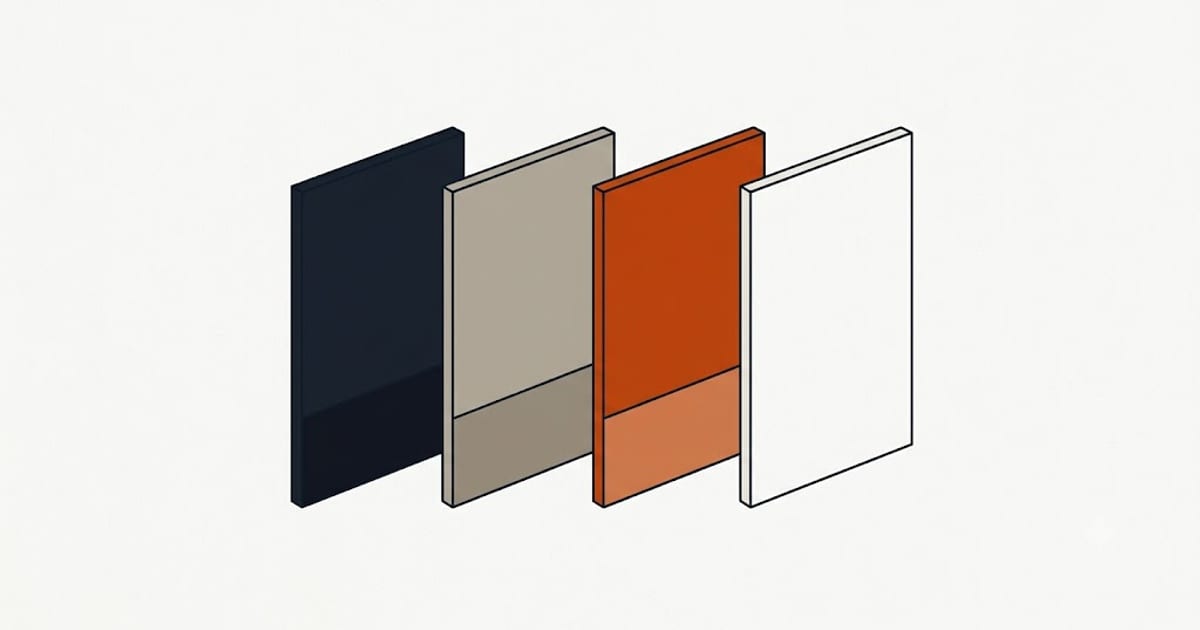
Light over dark does not use more paint per coat. The paint spreads exactly as it always does — it just takes more coats, and the difference in cost comes from that.
What actually happens
Paint film is translucent. Each coat blocks a fraction of what is underneath, so hiding is multiplicative rather than additive.
A single coat over a dark wall lets enough through to read as patchy. A second coat blocks most of the remainder. A third finishes it. Which is why the answer is almost always three finish coats, or two over a tinted primer.
The arithmetic, on a 365 ft² wall
Three finish coats: 365 ÷ 375 + 365 ÷ 431 + 365 ÷ 431 = 2.6 gallons of finish paint
Tinted primer plus two coats: 365 ÷ 375 primer + 365 ÷ 431 + 365 ÷ 431 = 0.97 gallons of primer + 1.7 gallons of finish paint
Primer costs roughly half what quality finish paint does, and one fewer finish coat is one fewer day of drying. The tinted route wins on both money and time, and it wins by more the larger the room.
Tint the primer to roughly half way between the old colour and the new one — most paint stores will do it free from the same tint base. A grey-tinted primer is the standard answer when going light over a saturated colour.
The colours that are worst
Deep reds, oranges and bright yellows are the hardest to cover and the hardest to achieve, because their pigments are inherently transparent.
Going to a strong red or yellow needs three coats over white, for the same reason in reverse — the pigment does not hide its own substrate. A grey-tinted primer under a red topcoat is standard trade practice and saves a coat there too.
Dark navy and charcoal going to white is the classic three-coat job.
Any colour to a similar-value colour is two coats regardless of hue. Value — how light or dark — matters more than hue.
Test before committing to the quantity
Paint a 2 ft square of the actual wall with one coat, let it dry fully, and look at it in daylight. Dried paint hides better than wet paint, so judging while wet always overestimates the number of coats needed.
That square tells you whether you are buying two coats or three, and the difference on a whole room is close to a gallon.
Sheen changes it too
A higher-sheen paint generally has a higher pigment-to-binder ratio and hides marginally better per coat. It also shows more wall imperfection, which after three coats of build is worth thinking about — the trade-off runs both ways.
What does not help
Thicker coats. A heavy coat sags, dries unevenly and takes far longer to cure. Two normal coats hide better than one thick one, every time.
"One coat" paints. They are thicker, higher-solids products and they genuinely do better than ordinary paint over a modest colour change. Over navy to white they still need two coats, and they cost about what primer plus normal paint does.
Waiting less between coats. Recoating before the previous coat has cured lifts it, and the result is worse hiding rather than better — outdoors the same rule has a temperature attached to it.
Ceilings that were part of the dark scheme
A dark ceiling going white is the same problem with worse ergonomics. Tinted primer matters more here, because a third coat overhead is a genuinely unpleasant day.
Work out the ceiling separately — it has its own area and its own spread rate — and buy for it as its own job.