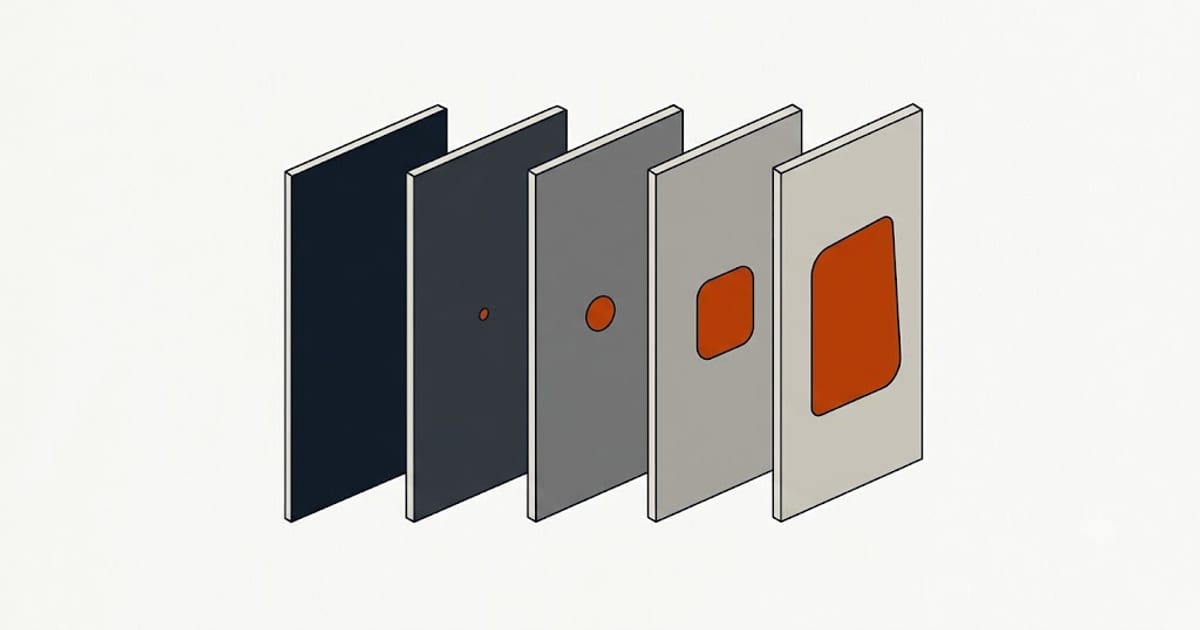
One trade-off governs the whole scale:
More sheen = more washable, and more visible wall imperfection.
Everything else is detail.
| Sheen | Gloss units | Washable | Hides | Belongs in |
|---|---|---|---|---|
| Flat / matte | 0–5 | Poorly | Best | Ceilings, adult bedrooms, low-traffic |
| Eggshell | 10–25 | Moderately | Well | Living rooms, dining, bedrooms |
| Satin | 25–35 | Well | Moderately | Hallways, kids' rooms, family rooms |
| Semi-gloss | 35–70 | Very well | Poorly | Trim, doors, bathrooms, kitchens |
| Gloss | 70+ | Best | Worst | Doors, cabinets, accent trim |
Why flat hides and gloss shows
A flat surface scatters light in every direction, so a dent or a proud joint returns light much the same as the wall around it.
A glossy surface reflects light directionally — it is closer to a mirror. Anything not perfectly in plane returns light at a different angle and reads as a shadow or a highlight.
Which means sheen is a decision about the wall as much as about the paint. On a wall finished to Level 4 with visible joints, semi-gloss will show every one.
Room by room
Ceilings: flat. Always. Ceilings get raking light from every fixture in the room, and flat is the only sheen that survives it. Ceiling paint is also formulated to spatter less, which matters overhead.
Bedrooms: flat or eggshell. Low traffic, and the walls get looked at in low-angle morning light.
Living and dining: eggshell. The default for a reason — enough washability for normal life, enough hiding for normal walls.
Hallways and stairs: satin. Shoulders, bags, hands, dogs. This is the highest-wear wall surface in a house and the one most worth stepping up.
Kids' rooms: satin. For the same reason, plus the ability to wash crayon off without burnishing.
Bathrooms: satin or semi-gloss. Moisture and cleaning. Semi-gloss on the walls of a small windowless bathroom; satin in a larger one with ventilation.
Kitchens: satin on walls, semi-gloss on trim. Grease comes off satin; it does not come off flat.
Trim, doors and cabinets: semi-gloss or gloss — and trim is the expensive line on any quote. Trim is meant to be a different plane from the wall, and sheen is how that reads. It is also what gets touched.
Why flat paint burnishes
Rubbing a flat surface polishes it locally, creating a shiny patch that is more visible than the mark you were removing. That is burnishing, and it is why "washable flat" is a compromise rather than a solution.
Modern "matte" and "washable flat" products are genuinely better than flat paint of twenty years ago — they sit around 5–10 gloss units and tolerate gentle cleaning. They still burnish under scrubbing.
If a wall is going to be scrubbed, choose satin and accept the wall showing.
Sheen names are not standardised
One brand's "eggshell" can be another's "satin". The gloss units in the table are the real measure, and the better manufacturers publish them on the technical data sheet.
If you are matching an existing wall, take a sample chip to the store rather than trusting a name.
Touching up
Flat touches up almost invisibly. Gloss does not. A touch-up on semi-gloss shows as a patch of different sheen even in the identical colour, because the new film dries at a slightly different gloss than the aged one.
Which means on a high-sheen surface, the unit of repair is the whole panel or the whole door — not the mark. Worth knowing before choosing gloss for a hallway.
Cost
Sheen barely changes the price within a product line. It does change spread rate slightly — higher-sheen paints are usually a little thicker and cover marginally less — so add a few percent when working out gallons for a semi-gloss job.