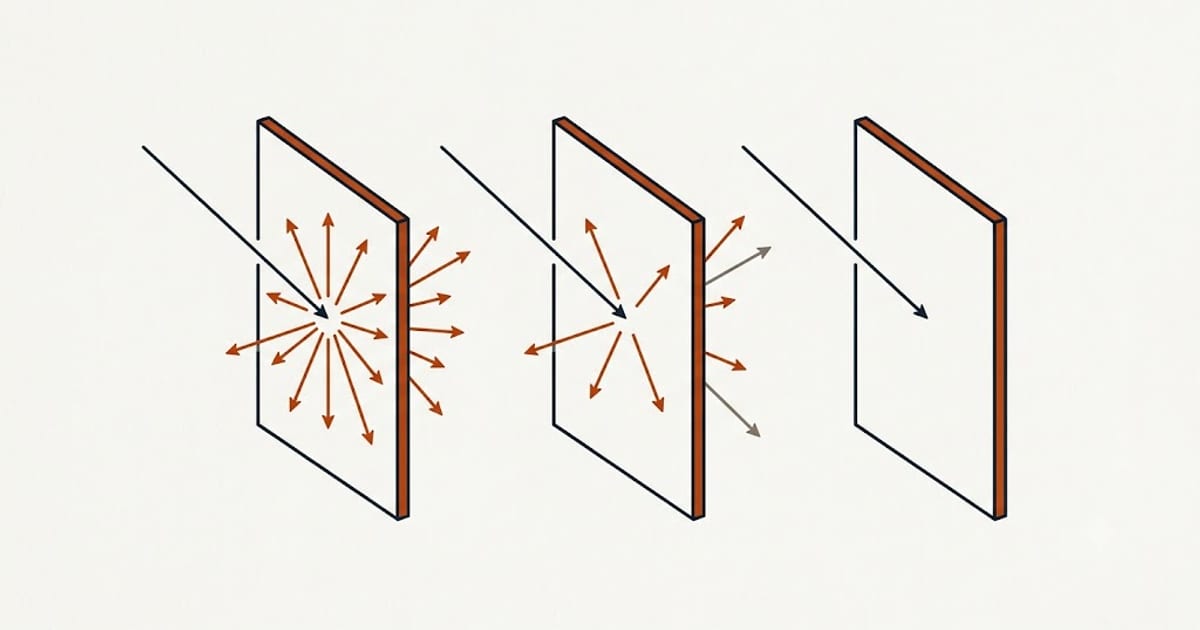
Sheen is the proportion of light a dried paint film reflects specularly — mirror-like — rather than scattering. Manufacturers measure it at a 60° angle and publish it as a gloss unit figure.
The three wall sheens sit close together on that scale and behave very differently in a room.
The three
| Gloss units, 60° | Reflectance | |
|---|---|---|
| Flat / matte | 0–5 | Almost none |
| Eggshell | 10–25 | Low, soft |
| Satin | 25–35 | Noticeable |
| Semi-gloss, for reference | 35–70 | Obvious |
Names are not standardised across brands. One manufacturer's eggshell can be another's satin, and "matte" now covers a wide range. Compare the gloss units on the technical data sheet, not the word on the can.
What each one trades
Flat hides everything and survives nothing. Maximum scatter means drywall joints, patches, roller marks and framing irregularities all disappear. It also marks readily and cannot really be washed.
Eggshell is the general-purpose interior wall finish. Enough sheen to wipe, little enough to hide ordinary wall imperfection. Most modern washable wall paints are formulated around this band.
Satin wipes properly and shows the wall. On a well-finished wall in a room without raking light it looks excellent. On an average wall it makes every joint visible.
Why flat paint burnishes
Flat gets its lack of reflection from a high pigment-to-binder ratio: pigment and extender particles sit proud of the binder film and scatter light in every direction.
Rubbing the surface — scrubbing a mark, a chair back, a shoulder against a hallway wall — polishes those particles flat. The rubbed patch then reflects more than the wall around it and reads as a shiny smear.
It is mechanical, not dirt. Washing it makes it worse. This is the single reason not to put flat paint in a hallway, and it is why the smear is always exactly where somebody tried to clean.
The modern "scuff-resistant matte" lines are flat paints with enough binder to resist this. They are a genuine improvement rather than a marketing one, at roughly twice the price, and they have largely replaced eggshell in new residential specifications.
By room
| Room | Walls |
|---|---|
| Bedroom, formal living | Flat or eggshell |
| Family room | Eggshell |
| Hallway, stairs | Eggshell or satin |
| Kitchen | Satin |
| Bathroom | Satin |
| Kids' room, playroom | Satin |
| Ceilings | Flat, near-universally |
| Trim, doors | Semi-gloss |
Ceilings are flat almost without exception, and it is not tradition. A ceiling is lit from below at a shallow angle by every lamp in the room — the worst possible light for showing surface variation — and any sheen at all turns every taped joint into a visible band. What a ceiling costs to paint assumes flat for exactly this reason.
Sheen and the drywall underneath
Every step up the ladder makes the wall behind it more visible.
A satin wall over a standard level 4 drywall finish shows the joints under side light. The same wall in flat does not. Which means the sheen decision and the drywall finish decision are one decision, and it has to be made before the taper leaves the site.
Specifying satin walls in a hallway lit from one end, over a level 4 finish, produces a result nobody is happy with and nobody can fix without skimming the whole wall.
Touch-up
| Sheen | Touches up |
|---|---|
| Flat | Nearly invisibly |
| Eggshell | Acceptably |
| Satin | Not at all |
| Semi-gloss | Not at all |
A satin patch has a different sheen from its surroundings because it was applied with a different tool, at a different thickness, at a different time. The only fix is repainting the wall corner to corner.
On a wall that will certainly be touched up — a rental, a child's room, a hallway with furniture moving through it — that argues one step down the ladder, and it is a stronger argument than the washability one going the other way.
Application
Higher sheen is less forgiving to apply. Lap marks, roller stipple variation and a wet edge that was allowed to set all show at satin and disappear at flat. It is slower work, and it is part of why a bid varies with the specified sheen.
Two coats is not optional above flat. One coat of eggshell over a sound wall dries with visible reflectance variation wherever the roller worked differently, and the second coat costs little extra in material.
Deciding in one minute
Hold a work light flat against the wall, pointed along it, in the room's own lighting conditions. What that reveals is what satin will reveal permanently, and what flat will hide.
Then ask how the wall gets touched. A wall that gets cleaned wants sheen. A wall that only gets looked at wants none.