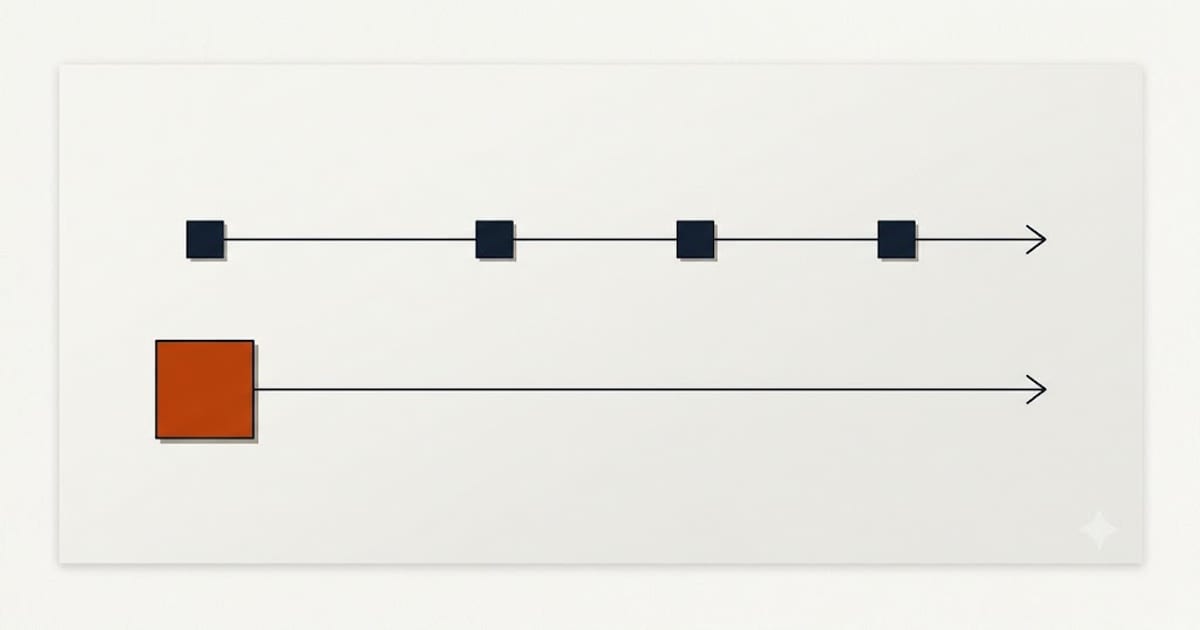
Painting costs a quarter of what replacement costs and lasts roughly a fifth as long. Over twenty years those figures land close enough that the money rarely decides it, and the substrate's condition does.
The up-front numbers
For a 2,000 ft² house with about 2,300 ft² of siding:
| Option | Cost | Expected life |
|---|---|---|
| Repaint, quality acrylic | $4,000–6,900 | 8–12 yr |
| Vinyl siding, new | $11,000–20,000 | 25–40 yr |
| Fibre cement, new | $18,000–32,000 | 30–50 yr |
| Engineered wood | $14,000–24,000 | 20–30 yr |
| Cedar, new | $22,000–40,000 | 20–30 yr, with maintenance |
Twenty years
Repaint at year 0 and year 10 — two cycles, allowing for costs rising:
| Option | 20-year total |
|---|---|
| Repaint × 2 | $9,000–15,000 |
| Vinyl, one install | $11,000–20,000 |
| Fibre cement, one install + one repaint at yr 15 | $23,000–40,000 |
Painting wins on twenty years, and by less than the up-front figures suggest. Push to thirty years and vinyl draws level; push to forty and it is clearly ahead.
Neither of these is why people replace siding.
When painting is not an option
Five tests. Any one of them ends the conversation.
1. Rot. Probe the bottom courses, around windows, and any elevation that stays wet. Soft wood is not a paint substrate. Spot-replacing a few boards is fine; widespread rot means the wall assembly has a water problem the paint would only hide.
2. Failed multiple times. Paint peeling within two or three years of a competent job means moisture is coming from behind — no vapour barrier, bathroom fans venting into the wall cavity, or missing flashing. Painting again gets the same result. This is a building problem, not a coating problem.
3. Hardboard siding delaminating. Pressed-wood products from the 1980s swell and split along the bottom edges once water gets in. Once swollen there is no repair, and paint accelerates failure by sealing moisture inside.
4. Vinyl. Vinyl can be painted, with two hard limits: only with a vinyl-safe formulation, and never darker than the original, because dark colour absorbs heat and warps the panels permanently. Cracked or brittle vinyl — common after twenty years of UV — cannot be painted usefully at all.
5. The wall is coming apart anyway. If insulation, wiring or a window replacement is opening the walls, the incremental cost of new siding is much lower than doing it separately later.
When painting is clearly right
Fibre cement in good condition. Takes paint extremely well and holds it 12–18 years. Replacing sound fibre cement to change colour is money burnt.
Sound wood siding. Cedar and redwood lap siding that is intact is worth maintaining rather than removing — it is a better product than most of what would replace it.
Stucco. Painting is normal maintenance. Replacing stucco is a major operation and almost never the answer to appearance.
A colour change on any sound substrate. This is the strongest case for painting there is.
Where the repaint cost actually goes
Prep, not paint. On wood it is scrape, sand, spot-prime and caulk — as much as the painting itself, and the reason cheap bids fail early.
Materials are 12–20% of the invoice. At 350–400 ft² per gallon on smooth siding a house this size takes 12 gallons for two coats. On textured stucco or brick, substantially more.
Brick is a one-way door
Painting brick is close to irreversible. Stripping it later is expensive and usually damages the face, and paint on brick traps moisture in an assembly designed to breathe unless a genuinely vapour-permeable masonry coating is used.
If the brick is sound and the objection is only its colour, consider that the decision cannot be undone by the next owner either.
The partial option nobody quotes
South and west elevations fail years before north and east ones. A house repainted entirely because one wall failed is common and unnecessary.
Repainting the two exposed elevations at year seven and the whole house at year twelve costs less over twenty years than two full repaints, and it keeps the house looking uniform for longer. It needs the same paint and the same batch discipline, and it is worth asking a painter to price as an option.
Getting the life out of it
Prep properly, use a quality 100% acrylic, apply two coats, and paint within the right surface temperature window — surface temperature, not air. Those four things separate an eight-year job from a five-year one, and none of them costs much.